
As we look forward to the upcoming 2026/2027 winter season, everyone is wondering: How will El Niño affect Mammoth Lakes? Will it mean an epic snowfall year? Should we expect nightmare travel conditions? And what the heck is the science behind El Niño, anyway?
We’ve lived through quite a few of these weather phenomenons over the decades, and we think it’s important to be clear and honest about what to expect and how to prepare. In this article, we’ll talk about what El Niño is, what the experts are predicting for the 2026/2027 season, and how you should plan your winter trip to Mammoth.
What is El Niño?
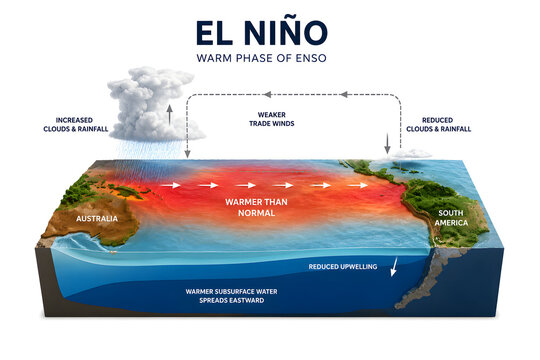
In order to understand what El Niño is, it can be helpful to talk about what happens during a normal year. During a non-El Niño year, the wind pattern over the Pacific ocean moves from East to West over the equator. This results in warmer sea surface temperatures around Southeast Asia and Australia. At the same time, cooler water comes up from the South to lower the water temperatures off the Pacific Coast of the Americas (hence why our surfers need wetsuits!) You might picture in your mind something like a big counter-clockwise cycle.
In an El Niño year, however, this pattern starts to reverse, starting around June and gathering strength over the next several months. Winds during this time move from West to East, bringing an influx of warm water to the western shore of the Americas. This change leads to a variety of weather outcomes: some areas see more precipitation and flooding, other areas will experience drier, warmer conditions.
What are the predictions for the Eastern Sierra 2026 and 2027 El Niño?
While El Niño is a well-researched phenomenon, understanding past events and predicting future ones are two very different things. So, while we can share some of the predictions experts like the Weather Channel and the University of California have published, we can’t know with 100% certainty how El Niño will impact our area.
That being said, there is a high likelihood that the Eastern Sierra will see:
-
No change in average daily temperatures typical for the winter season
-
Increased precipitation throughout the season
-
More intense winter storms with significant snowfall
What do the California emergency orders for El Niño mean for people traveling to Mammoth Lakes?
Given that El Niño has already begun, it’s not surprising that local governments have started to prepare for possible damages. Here in California, the governor has issued a state of emergency proclamation to make sure that areas experiencing severe weather will have access to resources and emergency personnel if necessary.
As of right now, the proclamations won’t have any affect on people traveling to Mammoth Lakes. But that could change depending on the severity of the winter season. We hate to say that it’s a “wait and see” kind of situation, but, well, it is.
The best thing we can say right now is that it will be important to keep track of weather conditions and plan with El Niño in mind.
What have El Niño years looked like in the past?
As we said, an El Niño phenomenon doesn’t guarantee any certain outcome. And a look at historical data shows that winter conditions here in Mammoth can’t be neatly linked to El Niño.
For instance, during the last El Niño, at the end of 2023 to 2024, Mammoth Mountain reported 367” of snow for the season. But it was the previous year, 2022/2023 that we had our record-breaking season, with 716”.
During the 2014 to 2016 El Niño, we experienced less snowfall than we would have liked, with 176” in the 2014/2015 season and 362” the next year. Once El Niño was over, we had another huge snow season, with 615” in 2016/2017.
Does this mean that we’re destined for less snowfall during an El Niño year? Not necessarily! During the 1997/1998 El Niño, we received 451”, which made for a great winter season.
How can you plan your trip with El Niño in mind?
Even though we can’t say for sure how El Niño will impact snowfall, it’s still a good idea to prepare for a potentially severe winter season. Here are a few ways that you can keep yourself safe during your fall or winter trip to Mammoth Lakes:
Keep an eye on the weather forecast
This one is a bit of a no-brainer, but it’s worth the reminder. Start checking the weather forecast within a few weeks of your trip so that you can decide how to plan accordingly. If you’re worried that an incoming storm will impact your travel plans, give us a call here at Mammoth Mountain Reservations, and we can help you weigh your options.
Follow Caltrans
CalTrans has the latest information on road closures, so it’s a good idea to follow them on social media or check their website for road conditions.
Sign up for emergency notices in every county you’ll pass through
We always recommend that visitors sign up for Emergency Alerts here in Mono County, but it’s also a good idea to subscribe to alerts in all of the counties along your route. After all, even if the weather here in Mammoth is good, you might pass through areas with rain or flooding on the way.
Consider investing in snow chains or cables and learning how to install them
When chains are necessary here in the Eastern Sierra, you’ll see areas where you can safely pull over and install them by the side of the road. If you didn’t bring your own, you can buy them on site and have a professional install them for you. Or, you can come prepared with your own chains or cables and practice installing them at home. This is the option that we would recommend, as it can save you money and give you the opportunity to learn how to install the cables in calm conditions.
Prep your home for your time away
El Niño may affect different areas at different times, so you also want to make sure that your home is taken care of while you’re away. Take a look at the recommendations from your local governing body on how to protect your home from severe weather, and let a neighbor or loved one know that you’re leaving.
Travel with an emergency bag
It’s always a good idea to have a bag of essential items in case you get caught in a storm. Bottled water, a first aid kit, extra blankets, a flare, a flashlight, jumper cables, an ice scraper, gloves and non-perishable food items (that you’ll remember not to leave in your car unattended, of course) can all come in handy if you find yourself stuck in the snow.
We would also recommend reviewing our blog on Car Care Tips for Your Next Trip to Mammoth Lakes.
More questions about El Niño? Reach out to us!
Here at Mammoth Mountain Reservations, we’ve seen our fair share of El Niño years and record snowfall! Give us a call so that we can help you with:
-
Accommodations for your winter trip to Mammoth Lakes
-
Questions about covered parking
-
Safety tips for traveling in winter
-
Recommendations for ski and snowboard rentals
-
Any other questions you have for what we hope is another epic winter season!